

Automation Without Compromise
September 18, 2025

In the kickoff to this series, we argued that data quality without compromise means rejecting the trade-offs that have defined the space for years. Depth or scale. Automation or control. Ease of use or enterprise rigor. These compromises were necessary when computing was expensive, and tolerable when data quality was a back-office concern. Now that we all rely on massive amounts of data for critical business decisions and AI training, it’s time to stop accepting tradeoffs.
One of the most significant contrasts between Anomalo’s approach and the competition is in automation. Legacy companies would like you to think they’re state-of-the-art, with promises of “minutes to reliability” or AI that writes rules on your behalf. On the surface, it sounds great: instant coverage, massive scale. But the result is a step change in coverage improvement, far from what’s possible when you reimagine data quality monitoring for today’s scale and computing power.
We want to show you what refusing to compromise means in terms of automation: why instant isn’t enough, why unsupervised ML helps you find more issues, and how automation improves the workflow for fixing those issues. The result is fewer costly mistakes, less employee time on monitoring and troubleshooting, and more data trust across the enterprise.
Instant, but then what?
You need great data quality monitoring indefinitely. So why do many vendors make such a big deal about how fast they are to set up? Maybe it’s because they’re hoping you make the false assumption that quick integration means comprehensive automation.
Some providers, like Monte Carlo with that “minutes to reliability” promise, offer metadata observability that can only detect surface-level issues like schema changes or missing values. The coverage you get in a half hour is just as good as what you’ll get in a year. Monte Carlo, and others lean on AI to generate lots of rules quickly, but that’s simply bolting faster workflows onto old technology. These are just two of several examples of quick-fix approaches that don’t add much value in the long run. They can’t learn from context, adapt over time, or find the unknown unknowns.
One Fortune 200 financial services company struggled with daily false positives, because the “automated” system they were using wasn’t sensitive to which variations actually mattered. As the technical lead for data governance put it, “Checks weren’t maintained because we were firefighting a backlog of requests from business users.” The system they tried may have been quick to produce alerts, but the pain of poor tuning was lasting. Switching to Anomalo alleviated this maintenance requirement while improving coverage.
The real benefits of true automation
Anomalo takes a different path, for deep insight, less noise, and broader coverage, all while offering even simpler setup. In fact, we’ve been ranked Easiest Setup by G2 for six consecutive quarters.
Just point Anomalo at a table and you instantly get the same metadata monitoring that observability vendors like Monte Carlo provide plus Anomalo starts to learn your data. Within a week or two, Anomalo’s proprietary AI learns what “normal” looks like for that table, uncovering correlations, adapting to seasonal cycles, and surfacing subtle shifts that deepen in accuracy and value over months and years. (Learn more about what goes into our unsupervised ML from the summary of a chapter from our O’Reilly book.)
You can still use rules to add peace-of-mind monitoring for specific segments, and you can manually adjust parameters or set up complex alerting workflows with a no-code interface. But you don’t have to do any of that to get extremely effective monitoring. In fact, by learning iteratively and independently, Anomalo detects up to 85 percent of issues automatically.
Another benefit to true automation is scale. With a traditional approach, you get thin metadata observability across as many tables as you please, but deeper looks only at the tables for which you (or an AI) have invested the effort to build and maintain rules. With unsupervised ML, if you can spare a few minutes once to set up a table, you’ll get automatic, high-quality, maintenance-free monitoring for years.
Case in point: Discover Financial estimated it would take 25 years to achieve full coverage of their current data with manual rules-based methods. Instead, they chose to automate data anomaly detection with Anomalo, so that Data SMEs can focus their efforts on triaging and resolving problems.
Find real issues and address them quickly
Finding errors is one thing. Fine-tuning to what is actually worth alerting on, and helping data teams find a quick resolution, makes automated data issue detection truly useful.
False positives are a big problem in data quality monitoring. Too many flags about things that don’t matter bring on the dreaded alert fatigue, risking a boy-who-cried-wolf situation where truly important issues are missed in all the noise. But that’s exactly what happens with rigid rules that can’t adapt to seasonal variations or gradual evolution of datasets, or recognize that dozens of issues are caused by a single upstream problem. Anomalo, by contrast, reduces false positives by continually adjusting the predicted value window, which can also be manually tweaked in the straightforward UI.
Once you’ve determined an issue might be worth addressing, root cause analysis (RCA) helps you find what went wrong. Most of our competitors choose one side of the compromise between deep insights (Monte Carlo) and ease of use (any flavor of “AI-driven” RCA). Our approach to automation offers both.
Anomalo’s RCA finds segments that are the most likely cause of the issue, so you don’t have to do the initial troubleshooting steps—where others say “there’s an issue,” we say “there’s an issue with this segment.” Our UI is approachable enough that an SME with no data science or even data analytics background could get a sense for the issue. Multiple easy-to-parse visualizations about the check results, validation steps, and anomalies democratize access to actionable data quality information.
Demand true automation
Teams using modern technology should be using modern infrastructure. If data is critical to your success, use modern approaches for more thorough, more useful monitoring. Not last decade’s approach with some AI bolted on.
Enterprises that have lived with rule-heavy or metadata-only approaches know how costly the trade-offs become. Anomalo’s customers—from Discover to Caseys to Block—have joined us in refusing false choices. You can have automation that is fast to set up, deep enough to add real value, and limitlessly scalable.
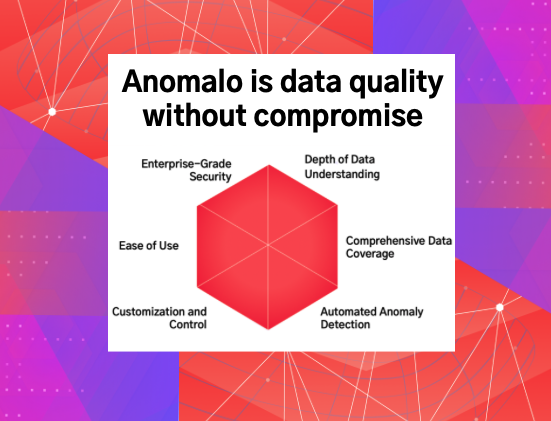
This is automation without compromise, one of the six ways Anomalo delivers data quality without compromise. Let a data quality expert show you what Anomalo’s automation can do for you.
Categories
- Data Governance
Related Resources
Learn more by browsing our library of announcements, guides, and technical deep dives on data quality.


Ready to Trust Your Data? Let’s Get Started
Meet with our team to see how Anomalo transforms data quality from a challenge into a competitive edge.