

Data Quality Without Compromise
September 9, 2025

Every era of technology has its defining moment—the point when the foundations either hold or crumble under the weight of new demands. For enterprises entering the age of AI, that foundation is data. And the truth is, most organizations are still building on shaky ground riddled with data quality issues, which is why 95% of generative AI pilots are failing to deliver measurable business impact.
For too long, data quality has meant making tradeoffs: depth or scale, automation or control, coverage or security. But now that most enterprises have built mission-critical processes and tools around this data — from product recommendations to loan decisions, inventory management to custom LLMs — these compromises are no longer acceptable.
So why do most data quality vendors continue to force customers into making compromises? Why are they ignoring both the power of modern computing and the critical need for trustworthy data?
At Anomalo, we reject the “or” mentality. You shouldn’t have to choose between depth or breadth, automation or enterprise-grade control, ease of use or rigor. With today’s technology, you can and must have it all. That’s why we stand for data quality without compromise. We help organizations trust their data at scale, across systems and formats, structured and unstructured, without endless setup or painful trade-offs.
To truly trust the data fueling enterprise analytics and reporting, and to build confidence in their AI deployments, organizations need these six pillars of data quality monitoring in place. Fortune 500 leaders like Discover and Block choose Anomalo because we’re the only vendor to deliver on them all:
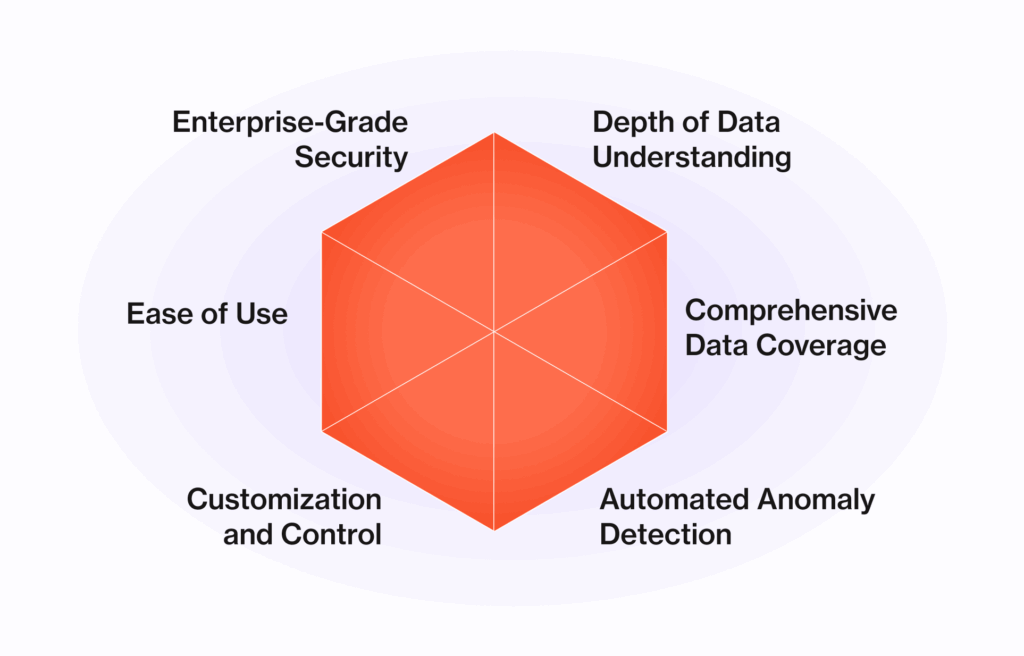
Enterprise-Grade Security and Scale
A data quality solution that cannot scale or meet security and compliance standards is a non-starter for the enterprise. Large organizations typically have strict requirements for auditability, data residency, and regulatory compliance.
Anomalo was built to meet the strictest enterprise data security standards, serving customers in tightly regulated industries such as financial services, healthcare, and insurance that manage massive volumes of sensitive data. We are SOC 2 Type II certified, encrypt data in transit and at rest, and give customers the option to manage their own keys. Deployments can run entirely within a customer’s VPC, ensuring that data stays within established security boundaries. And with integrations into data catalog and orchestration platforms, including granular controls for sensitive information, Anomalo complements even the most complex governance frameworks.
Depth of Data Understanding
Some vendors, such as Monte Carlo, rely on metadata checks to find hints of issues in your data. This shortcut, known as observability, comes at a steep cost: surface-level checks miss abnormal values, hidden correlations, and subtle distribution shifts that quietly distort dashboards, analytics, and AI models. And the price of those misses is steep. Poor data quality costs organizations an average of $12.9 million annually, while also adding long-term complexity and eroding decision-making. We’ve been sounding the alarm on insufficiently deep data quality for years.
Anomalo hunts for and finds the issues observability misses. It’s been smart from the start, leveraging unsupervised machine learning (ML) years before everyone was talking about AI. For structured and semi-structured data, our platform automatically learns the normal patterns of your tables and flags both the “loud” anomalies everyone notices and the “silent” shifts that most tools miss. For the unstructured data now fueling enterprise AI, we use LLMs to inspect content quality directly, screening against standards like relevance, completeness, bias, and toxicity so that flawed inputs never reach your training sets.
Put another way, to truly detect data quality issues, first a product must be able to understand your data estate. Not just your surface metadata, but the contents of your data. Anomalo ensures that every decision and every model is built on data that is complete, accurate, and trustworthy, eliminating blind spots before they can erode trust.
Comprehensive Data Coverage
Enterprises often manage tens of thousands of tables with billions of rows across sprawling data stacks. Covering only a few high-profile tables isn’t enough; an issue in any data you use means one of your processes or teams may be basing decisions on wrong information. And with more than 80% of enterprise data now unstructured, a figure growing at a rate of 40-60% per year, most vendors leave critical blind spots by just focusing on structured data, just as organizations prepare for AI.
Anomalo monitors all data types including structured, semi-structured, and unstructured data. This coverage extends across the modern data ecosystem—warehouses, lakes, catalogs, storage buckets, pipelines, and BI tools—to evaluate quality and signal status directly where teams already work. And thanks to LLM-powered analysis that runs natively inside environments like Snowflake Cortex and AWS Bedrock, Anomalo now can evaluate the readiness of massive volumes of unstructured text securely where they live, before they train your next model. No matter where in your stack you store or use the data that matters, Anomalo’s ready to monitor it.
Automated Anomaly Detection
Legacy vendors, like Informatica and Collibra, rely on rules-based approaches to data quality, which place the burden on enterprises to configure, manage, and update complex rule sets. Comprehensive coverage at enterprise scale is impossible to manage with rules alone. Tens of thousands of tables and billions of rows generate too much complexity for manual checks to keep up. Some vendors try to shoehorn their way to scale by using AI to write rules automatically, but that’s just scaling yesterday’s methods with today’s tools. The problem is that rules, no matter who (or what) writes them, only catch issues you know to look for.
Anomalo takes a radically different approach, which you can read about in our O’Reilly book. Our proprietary intelligence uses AI to learn what “good” looks like in your data, automatically catching more than 85 percent of issues without manual configuration. It’s really that simple: tell us what to monitor, and within a week or two, we’ll have far deeper coverage of any table than armies of rules could dream of. Not only does it cover more, it covers smarter, accounting for seasonal and periodic variation to reduce false positives, and providing automated triage and root cause analysis to help teams pinpoint and resolve issues fast. Instead of endlessly generating rules and chasing issues after they’ve become problems, teams can focus on higher-value work, like how ADP’s data governance team reduced its time working on quality issues by more than half.
Ease of Use
Monitoring, no matter how thorough, is only useful if people can adapt it to their needs. Users such as business analysts, operations managers, and ML engineers all need to know they can trust the data in front of them or understand what’s wrong with it, without having to bug someone on the data team.
Anomalo was designed for all data users: Non-technical users can understand what’s wrong and see the context behind it, while technical experts still have the depth and flexibility they expect. The interface offers no- and low-code tooling for easy setup and adjustment by less-technical teammates, while SQL affords data experts the power to go further, faster. Dashboards summarize health trends and display issues using intuitive visuals. With our deep investment in partnerships and native integrations, statuses and alerts appear in the systems teams already use—data warehouses, catalogs, or BI platforms—so they’re visible exactly when users most need them. We’re proud to be recognized by G2 as having the Easiest Setup for six consecutive quarters—a distinction driven by how highly our customers rate the simplicity of our setup and go-live process. When people across teams can act on data quality in ways that fit their roles, ease of use becomes a foundation for trust across the enterprise.
Customization and Control
A solution can check all the boxes, but if it lacks the flexibility to tailor to a company’s unique business rules, regulatory requirements, or operational priorities, it will fail. They must be able to track the metrics that matter most to them in the tools they’re already using, tweak rules and settings to their needs, and direct alerts to the right people. Without that adaptability, even the most powerful platform will create noise, trigger alert fatigue and water-cooler grumbles, and ultimately erode trust.
Anomalo offers rigor and flexibility. Data teams can layer on custom checks, write SQL rules, or specify key metrics to ensure their most important numbers are always covered. Alerting is designed for precision: Each table and check is assigned to specific people or teams, with notifications sent through their preferred channel and settings that can be tuned depending on the business-criticality of the data. By adapting not just at the organization level, but to the specific needs of each team, Anomalo’s data quality monitoring is designed for everyone’s workflows.
Anomalo stands for “and.” Depth and breadth of coverage. Automation and compliance. Customization and ease of use. Your data, and the decisions, models, and strategies it powers are too valuable for anything less.
There’s a lot more to share on each of these six pillars. In upcoming posts, we’ll call out competitors that force their customers to compromise, and show how Anomalo works differently so its customers can increase their trust in their data while spending less time repairing it. But the path forward doesn’t have to wait. Now is the time to replace tradeoffs with trust, blind spots with clarity, and compromise with confidence. Get in touch and let us show you how Anomalo can make your data, and your AI, ready for the future.
Categories
- Data Governance
- Integrations
- Partners
- Product Updates
- Unstructured Data
Related Resources
Learn more by browsing our library of announcements, guides, and technical deep dives on data quality.

Ready to Trust Your Data? Let’s Get Started
Meet with our team to see how Anomalo transforms data quality from a challenge into a competitive edge.