

Introducing Self-Driving Data and the new Anomalo Agentic Platform
April 2, 2026
For years, the way to get value from enterprise data has been to hire talented people, point them at dashboards and data warehouses, and hope they spot and find what matters. Your best analysts spend their mornings figuring out why their metrics have changed.. Your data engineers manage a constant stream of data issue alerts, triaging which ones are real and which ones are noise. Your business teams wait hours or days for answers to questions they needed answered an hour ago.
This is not a people problem. It is a model problem. And today, we’re changing it.
Today, Anomalo is introducing Self-Driving Data, a new category of autonomous Agentic AI data systems that monitor themselves, investigate what changes, and surface what matters, all before anyone has to ask. We are launching our Agentic Platform, a suite of nine specialized AI agents that together eliminate the manual, repetitive work consuming most of every data team’s day. And we’re announcing the general availability of our Conversational Analytics Agent, Anomalo’s Intelligent Data Analyst (AIDA), along with the launches of our Data Insights Agent and Data Documentation Agent, capabilities that, frankly, I’ve wanted to build since we founded the company but the technology simply wasn’t available until now. .
This is the most significant thing Anomalo has ever shipped. I want to explain why we built it this way, how it works under the hood, and what it means for the enterprise data teams using it.
The model was already broken. Agentic AI is making the gap undeniable.
Every data leader I talk to describes some version of the same situation. Their team is extraordinarily skilled and they’re also extraordinarily busy doing things that should not require their skills.
Monitoring dashboards to spot unusual patterns. Writing one-off SQL queries to answer questions that surface in Slack or email. Triaging data quality alerts to figure out which 20% represent real issues. Manually maintaining documentation that was accurate when written, but wrong by the time anyone reads it. Building the same report three different ways because three different stakeholders define the same metric differently.
Just a few years ago, the best AI could handle tasks that might take a human about 30 minutes to complete. Today, leading frontier models can independently finish work that would require a human as many as 14 hours. And there’s no sign that progress is slowing down. We’ve seen this firsthand working with our customers to deploy agentic AI tools. It’s become clear to me that every part of what data teams do today will be dramatically improved and that all routine data team tasks will eventually be handled autonomously by AI agents. Not years from now, but months from now.
I’ve started calling this new world Self-Driving Data. Imagine a world where data teams no longer manually compose queries to answer questions, constantly refresh dashboards to understand what’s going on, or spend their days triaging and resolving data quality alerts. Instead, autonomous AI agents handle those tedious tasks while humans set strategy and direction, the same way you set a destination for a self-driving car rather than turning the wheel. That’s what we’re building towards.
What we’re building, and how it works
To achieve Self-Driving Data, Anomalo is evolving into an Agentic Platform with a suite of nine agents, built on top of the proprietary data profiling and prediction engine we’ve spent years developing. Let me walk through each of them and how they fit together.
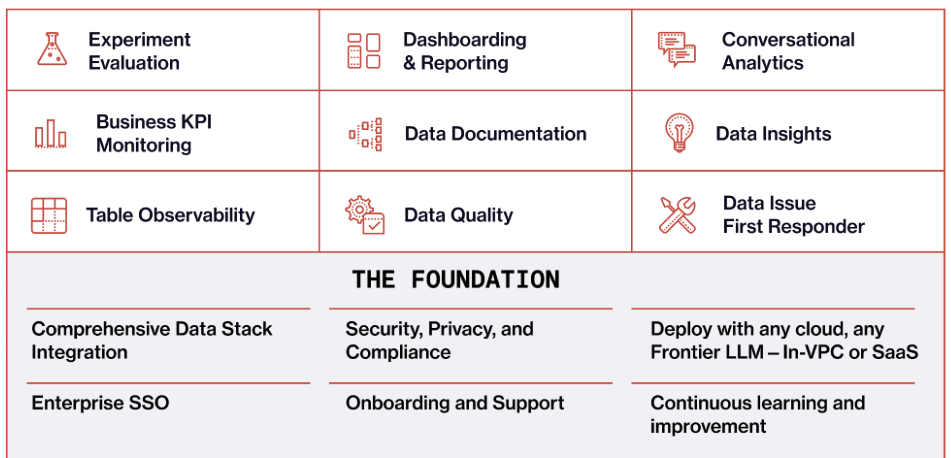
Our Foundation Is What Makes These Agents Different
Most AI agents know what’s in your data. Anomalo knows what’s normal. That distinction is everything. Over years of building the deepest automated data quality platform in the enterprise, we developed a proprietary profiling and prediction engine that doesn’t just monitor your data, it understands it. How it behaves at scale. How it shifts over time. What’s signal and what’s noise. That engine is the foundation that every Anomalo agent runs on, and it’s built to work across your entire data stack, connecting to the warehouses, data lakes, pipelines, and tools your team already uses. It deploys in-VPC or SaaS, on any cloud, with any frontier LLM you choose, all with the enterprise-grade security controls, access management, and compliance standards your organization requires.
And unlike tools that start cold and stay that way, Anomalo gets smarter the more you use it. Every interaction makes the system more accurate and more relevant to your business over time. That combination of deep data intelligence and enterprise-ready infrastructure is what makes every agent we’re announcing today different from anything else on the market.
Our Agentic Suite
- Table Observability Agent – Generally Available
This is always-on monitoring of data availability, freshness, and schema consistency. Is this table arriving on time? Is this partition populated? Did a column disappear overnight? The Table Observability Agent watches your pipelines continuously and raises the alarm the moment something deviates from expected behavior, before any downstream consumers are affected.
- Data Quality Agent – Generally Available
Our original core capability, now operating as a full agent. Define what good data looks like through natural language without having to write any brittle rules by hand. The Data Quality Agent applies our data profiling and prediction engine to continuously monitor for any deviations that might break dashboards, reports, and other AI models and agents. It learns what normal looks like and flags what isn’t.
- Data Issue First Responder Agent – Coming Soon
Today, when a data quality issue is detected, an alert fires and a human has to receive it, interpret it, decide whether it’s critical, check a runbook, figure out if it affects downstream reports, and decide what to do. That sequence can take hours. And it requires a skilled person to execute it.
The First Responder Agent changes that by automatically investigating and taking action on data issues. The Agent receives and investigates data issue alerts to assess impact and criticality and then follows any established runbooks or policies to take appropriate action, including initiating workflows in tools like ServiceNow and JIRA and appropriately escalating to human team members. And everything it does is logged and auditable.
- Data Insights Agent — Now Available in Preview
This is the launch I’m most excited about. I’ve spent over 20 years working with the best data teams – teams that were always marked by an obsession with proactively understanding what was happening in their key data. They would build elaborate dashboards, write recurring queries and reports, and set aside time each morning to look at what changed overnight. The output of that obsession, the informed, contextual understanding of what was going on in the data, was enormously valuable. But it was entirely dependent on individual effort and couldn’t scale.
Our Data Insights Agent automates that obsession entirely so you never miss out on an important change or issue in your data. The Data Insights Agent proactively and autonomously identifies any noteworthy changes in your data then launches an investigation automatically, with no human prompt required. It queries the affected table and related tables, cross-references historical patterns from our data profile, reasons about what could explain what it observes, and delivers an analyst-grade report including what has changed, why it likely happened, what data is affected, and what action to consider. The output is delivered proactively to the people who care about that dataset, without anyone having to log in and ask.
- Conversational Analytics Agent (AIDA) — Now Generally Available
AIDA, Anomalo’s Intelligent Data Analyst, previously announced late last year, is now generally available. But I want to explain AIDA’s role in the new platform, because it’s different from how most AI analytics tools work.
AIDA plays two distinct roles. First, it’s a specialized agent for conversational analytics. AIDA can answer questions about your data via natural language and can generate the appropriate SQL queries and data visualizations, all grounded in Anomalo’s deep data context. When a user asks a question through AIDA, the system knows which tables are relevant ( based on which tables are monitored and for what)) and what data is available inside those tables (based on Anomalo’s automated data profiling).That context is what separates AIDA from a generic text-to-SQL tool running against a cold schema.
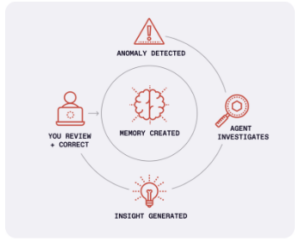 Second, AIDA is the conversational interface to the entire platform. When the Insights Agent surfaces something and you want to drill deeper, you ask AIDA. When the First Responder flags an issue and you want to understand its downstream impact, you ask AIDA. When you want to configure a new agent workflow, add a data domain, or adjust what tables are monitored, you do it through AIDA’s natural language interface. In practice, AIDA is how humans stay in control of an increasingly autonomous system without having to babysit the data.
- Data Documentation Agent — Now Available in Preview
Documentation is perhaps the most universally broken thing in enterprise data and the problem has gotten materially worse as AI agents have entered the picture. A human analyst can ask a colleague to explain an ambiguous field whereas an AI agent cannot. If the documentation doesn’t exist, the agent guesses, and errors compound downstream.
Our Data Documentation Agent fixes this by pulling context from the sources that actually contain knowledge about your data across chat channels, existing wikis, file shares, and runbooks, schema metadata from your data platform, and Anomalo’s own data profiling. For tables with no existing docs, it generates the documentation from scratch. For tables that already have manually written documentation, it enriches existing documentation by adding context without overwriting what humans wrote. Everything agent-generated is traceable to its source, and can be refreshed when something changes. Every table this agent documents also gives AIDA richer context for answering questions accurately and closes the loop between your documentation layer and your analytical layer.
As we continue down the road to Self-Driving Data, we’re also building three new agents that will be available in the coming months.
- Dashboarding and Reporting Agent — Coming Soon
The Dashboarding and Reporting Agent will build continuously-updated dashboards and reports on the data and metrics that you care about, purely via natural language. It will leverage Anomalo’s large library of data visualizations and reporting templates to provide analyst-grade snapshots of your important business metrics and trends. Users can also enhance any report or dashboard with Anomalo’s built in time-series predictive modeling, allowing for quick identification of any anomalies or unusual changes in your data. You don’t configure charts. You express intent.
- Business KPI Monitoring Agent — Coming Soon
The Business KPI Monitoring Agent will extend our observability and data quality capabilities explicitly to business metrics. Users define any important business metrics in natural language and the KPI Monitoring Agent will monitor it continuously for any unexpected changes and anomalies. No need to regularly check dashboards or run queries as the agent will alert you if something unusual is going on.
- Experiment Evaluation Agent — Coming Soon
The Experiment Evaluation Agent will automatically evaluate any experiments or A/B tests by defining both the test setup and the key evaluation metrics via natural language. The Agent automatically applies the correct statistical techniques to continuously evaluate your experiment, draw appropriate conclusions, and dig deeper to fully understand the results such as evaluating each experiment across your key customer segments.
Why Anomalo is where this had to come from
Self-Driving Data is not a rebrand of what we already built. It’s the destination everything we’ve built was always pointing toward.
There’s an important distinction worth making here. In a world where everyone is racing to ship AI agents, the question isn’t who can move fastest, it’s who can ship agents that actually work in the real complexity of enterprise data environments. Agents that have been designed for purpose, tested against real-world edge cases, and built to be trusted with decisions that matter. Shipping an agent in a week is easy. Shipping one your team can rely on at 2am when a critical pipeline breaks is something else entirely.
That’s what years of working at the content layer of enterprise data gives you. Anomalo didn’t start with agents. We started with deeply understanding what normal looks like across billions of rows of complex, messy, real-world data. That foundation is what makes our agents different from LLM wrappers pointed at a schema or observability tools that only check metadata. Our agents know your data. They’ve been trained on it, tested against it, and designed to reason about it in ways that hold up under production conditions.
The companies that will win in the age of AI are the ones that understand their data best, at a speed only autonomous systems can sustain. We built this to help you get there. Self-Driving Data is not about replacing your team, it’s about ending the parts of their job that should have been automated a long time ago, so they can focus on the parts that can’t be.
Related Resources
Learn more by browsing our library of announcements, guides, and technical deep dives on data quality.


Ready to Trust Your Data? Let’s Get Started
Meet with our team to see how Anomalo transforms data quality from a challenge into a competitive edge.